
- Constantly dripping water creates lots of choices, starting with doing a fast fix or the right fix.
- Sometimes the simplest thing is the best thing to do, sometimes not. It’s important to know the difference.
- Fast fixes are hardly ever permanent fixes.
- Right fixes take longer and last longer.
- It’s important to limit choices before you see the first option, because the world is full of too many choices. It’s vital to select the right filter before limiting choices.
- Inviting an expert to help makes for better results and removes the misery of trying to work outside your own skill set.
- An expert has sources you don’t have and has seen the good, the bad, and the ugly.
- Be nice to your expert and he will give you options that will save you from doing ugly.
- Your expert may have ideas you have not considered. Listen carefully.
- Responsible folks clear the mess before they leave. Having to start the next session by dealing with a mess first makes the workday and worksite uninviting.
Author: rene.shelton



When Anxious Thoughts Come . . .
Capture those thoughts. Don’t let bothersome or random thoughts sidetrack you just because they come into your mind. Always keep a note pad nearby and capture them by writing them down. Leave enough space so you can tear them apart and still have room to make some notes.
Process those thoughts. When you are learning to capture thoughts, you may want to process them after you finish with the current task. As you trust that thoughts can be captured, schedule regular processing times with longer timespans between (for example, one a day). Either way works.
- Clear enough space to have room to create 4 piles: (1) your working pile, (2) an action pile, (3) a discard pile.
- Tear your captured thoughts apart so you can handle one at a time. Don’t worry this is “work product.” It should not be pretty and neat. Stack the thoughts in your working pile.
- Pick up one thought and ask yourself the questions below.
- Individually address every thought in your working pile. Work fast. Trust that you know the answers to these questions. If you don’t, ask someone who doesn’t seem to worry much to help you learn to do this.
Is there any truth in this thought? If not, what is the truth about this thought?
- I don’t know if there is anything truthful here. Ask yourself, “Where can I go for the truth about this thought?” and make a note to trace down the truth first. Let’s focus and attend to things that are truthful. Remember, source of truth must be reputable! Place this note in the action pile. Pick up your next thought.
- Is this something that is not true I need to consider addressing and correcting? There are times we are called to address lies. It’s important to hear what God wants us to focus on. You action should be to seek instructions from God first. Make that note, place this in your action pile and pick up to the next thought.
- No, this is really not true. Disregard the thought by laying it in the discard pile and pick up your next thought.
- Yes, this is truth. Ask, “What is the truth in this thought?” We want to limit our focus on things that are truthful. Make notes you want to remember. Go to the next question.
Is this something that I am responsible for and/or have control over?
- I don’t know if I’m responsible for or have control over this matter. Ask yourself, “Where can I go for the truth about my responsibility?” and make a notation to consult. We want to limit our focus on those things that are within our sphere of responsibility and/or control. Place this note in the action pile, because you need to know the answer to this question before you answer others. Pick up your next thought.
- No, I’m not responsible nor do I have control over this. Disregard the thought by laying it in the discard pile and pick up your next thought.
- I’m responsible but I have no control over this. Ask yourself, “Who has control and how can I help them responsibly handle this concern? What do they need to know?” This is an opportunity to influence. Note your answer on the page and go to the next question.
- I’m not responsible but I have control over this. Ask, “How can I help the one who is responsible learn to address this concern appropriately? What do they need to know?” This is an opportunity to teach and train. Note your answer on the page. Go to the next question.
- Yes, I’m responsible and have control over this. Go to next question.
What is the best way to address this concern?
- I don’t know the best approach. Ask yourself, “Who can help me determine the best way to handle this concern?” Note who you need to consult. Remember, ask someone who is wise and will give good advice. It’s always helpful to ask God what to do. Make the notes needed, put this in your action pile and pick up your next thought.
- I have some ideas. Create a plan and put this thought in your action pile and pick up your next thought.
Now you have a discard pile and an action pile.
Move the discard pile out of sight. Learn to let go of the the discard pile. First, ask God to take care of these thing over which you have no control, responsibility, or influence. Then, move the pile out of sight. It could go in the trash. This is a physical way of letting go of those things over which you have no control or that are
Ask this last question for every thought in your action pile:
Is this something that I need to address now?
- I don’t know if this is the right time. Ask yourself, “Who can help me know when to address this?” Then talk to that person. Timing is very important. Don’t act until you understand the timing needed.
- No, this is not the right time. Make a note in on your calendar and return to it at that time. Put the note in a place where you can get to it when the right time arrives.
- Yes, this needs to be addressed now. Get to it. Taking action based on good decision-making helps defeat anxiety!

When My Cares Within Me Are Many
ANXIOUS THOUGHTS
Much has been written about anxiety and anxiousness recently. May I share with you how the Bible addresses anxious thoughts and worry?
In Psalm 94:19, King David penned these words: When my cares within me are many, Your comforts cheer me up. (from the Complete Jewish Bible). Hebrew is a pictorial language. Let’s look at the picture of what anxious thoughts can do to our mind.
• When my cares (within me) are many – This phrase refers to an abundance in number, in size, in duration, and even in quality (in a good or bad sense). It is very much like the individual drops when it rains. Alone one drop is not bothersome and, even when drops increase in number, you may not need to cover up. A slow gentle rain is easily soaked up by the ground and is actually helpful. But when raindrops increase in size, frequency, and speed, a thunderstorm occurs. Often large, severe thunderstorms do massive amounts of damage. Anxious thoughts are like that gentle rain. We are human. We will all have anxious thoughts. When we discuss them with God and we get His perspective, He helps us take these thoughts and use them to prepare us for the future. But when anxious thoughts multiply in our heads unchecked, we often run ahead of God. We become distracted trying to ensure everything will work out right and we fail to remember that our view is limited while His is not.
• Within me – The distracted mind here is described as branches lopped off a tree. A destructive thunderstorm leaves downed power lines, disconnected limbs, fallen tree trunks and all types of other debris in its wake. Simply being anxious or feeling nervous about what’s coming next is like collecting the limbs in your own yard, sorting through them so you can effective deal with them. Unchecked anxiety is like piling up all the disconnected limbs from your yard, along with all the limbs from every other yard all over town. It’s possible they came to you by natural means (like the wind) or neighbors pushed them into your yard, or the enemy came and dropped them off, or you went out and collected them yourself. At any rate, now it’s hard to tell which ones are truly yours. That’s why Paul wrote we have to take every thought captive. We think about what we are thinking about and ask God to help us know which thoughts are the ones to keep and which ones must be tossed out. It’s a skill that the Holy Spirit wants to teach us.
• Your comforts cheer me up – The word picture here involves breathing. Have you noticed how much is written in our world today about breathing when you are anxious? It’s not a new idea! But we must be clear about the focus of our breathing. Notice the capital Y on Your? That means God. God’s comforts cheer me up. The breathing here starts with sighing. Sighing is a sign of fatigue or sorrow. It may be an involuntary breath or an intentional exasperated breath. Either way, it expresses a discomfort or displeasure. Sighing is part of human life, but you don’t have to continually live with sighing. “Your comforts cheer me up” describes something that God does. We are passive and must let Him cheer us. How? By allowing God to breath upon us, to refresh us and allowing the Holy Spirit to remind us of the promises Jesus made: When four friends dropped their friend in front of Jesus, He told the man, “Son, be of good cheer; thy sins be forgiven thee.” (Matt 9:2). When the disciples were in the middle of the sea, in the middle of the night, in the middle of the storm unable get to shore, and they were frightened by a man walking on the water, Jesus told them, “Be of good cheer; it is I; be not afraid (Matt 14:27). In His last discussion with the disciples, when Jesus told them that there would be trouble, He added, “But be of good cheer, I have overcome the world.” (John 16:33). In every one of these places, the Hebrew translates “good cheer” as courageous or brave. Our task is to stay close enough that we can hear His voice
Dear Heavenly Father, I see lots of disconnected limbs from storms raging all around me. I know it won’t be long until my gaze is averted to the storms and destruction and sighing will come from my lips. Your Word tells me to bring the multitude of thoughts, the concerns, the what-if’s, the maybe’s to You, so here I am. Help me not to grasp and hang on to these things that will distract me from hearing and doing what You have called me to do. When my thoughts are not connected to Your truth and when plans and ideas fall to the ground, rather than trying to repair things on my own, help me first capture the thought, run to put it in Your mighty hands, and then listen for Your instructions. Remind me to let You turn my sighing into courage. I can’t do that on my own. Dear Jesus, remind me of Your promises: You are with me. You have forgiven my sins. You have overcome the world. Thank You for Your sacrifice. Thank You for the model of lovingkindness and compassion You set. Help me to live as You did, completely reliant on Your Father in Heaven so that Your gentleness, kindness, faithfulness, and compassion flows through me to those around me.

When Truth is Suppressed
When truth is suppressed, thinking disappears.
When thinking disappears, actions are driven by feelings and passions.
When feelings and passions alone drive actions, chaos and disorder arise.
When chaos and disorder arise, morality is lost.
When morality is lost, truth is actively destroyed.
Some Things are Eternal and Established
I found these notes in one of my old journals:
Just because there are those who don’t believe in ______, it doesn’t eliminate or diminish ______. ______ was and is and will be – regardless of what we believe and do.
Just because there are those who don’t believe in Truth, it doesn’t eliminate or diminish Truth. Truth was and is and will be – regardless of what we believe and do.
Just because there are those who don’t believe the Word, it doesn’t eliminate or diminish the Word. The Word was and is and will be – regardless of what we believe and do.
Just because there are those who don’t see God’s faithfulness, it doesn’t eliminate or diminish God’s faithfulness. He was faithful, is faithful, an will be faithful, regardless of what we believe and do.
What other things can you put into that blank?
How To Explain Death to Children
I was probably about six years old when my mother explained death to me. My newly-born cousin died and I went with my parents to the graveside service, but I stayed in the car. Curious about what was happening, I asked Mom and her explanation went something like this:
We are Two Parts
If I asked you to bring me milk from the kitchen, what would you bring me? . . . .Yes, milk, but you would have something else with you. Think for a minute and let me know what that would be. . . . If I asked you to bring me milk, you would bring me milk – in a carton. You can’t really carry milk without some kind of container, a carton.
People are made like the milk and the carton. There’s the part of us everyone sees – our body. That’s our carton, our container. People’s cartons come in all shapes and sizes. Our cartons grow as we get older. Inside our cartons, inside our body, we carry the part of us that makes who we really are. People call it different things. In our family, we call it your soul. Others sometimes call it your spirit or your personality. Your soul is made up of three parts: your mind where you think, your heart where you feel, and your will where you make decisions. We can’t see souls, but it is the part of you that looks out the windows of your carton – your eyes. Look at me. My soul is looking out my eyes and is looking at your eyes and your soul is looking back at me. Your soul stays in your body unless there’s a problem with your body, just like milk stays in the carton unless there are problems with the carton.
What Happens When the Carton Fails
What kinds of problems would cause milk to come out of the carton? . . . When something is working for a long time, it gets tired and becomes weaker. If the carton gets old or isn’t taken care of, it might get holes or become weak. Then, it won’t be able to hold the milk anymore. That usually takes a long time. When people get old, their bodies have been working for a long time. Their bodies become tired. Eventually it either starts working the wrong way or it stops working altogether. Often doctors can help along the way, but eventually, everyone’s body will stop working. Remember that usually doesn’t happen until you are old.
If there is a hole in the carton or it gets a tear that’s deep enough and big enough and isn’t fixed, then the milk will leak out. The same thing is true for your body and your soul. Your body has a lot of ways it takes care of itself and we have doctors who can usually fix problems with your body. But sometimes they can’t fix the problem, and if that happens, eventually your body will not be able to hold your soul any more. (That’s what happened with your cousin. [then she explained in simple terms what had happened]) Remember your body is strong and will work to heal itself and we have doctors who can help if your body has problems.
Let’s talk a bit about what happens when your body and soul are separated – like when the milk is not in the carton anymore. When the milk is out of the carton, the carton is empty. The thing that made it a milk carton – the milk – is not there. When your soul leaves your body, the part of you that makes you move and laugh and cry and grow and learn is not there anymore. That part of you goes back to God. He made it and He welcomes you back when you die. Other families believe other things, but I want you to know what we believe first.
This is a very brief overview of the conversation and conversations I have had with many children who have experienced death. I hope you find it helpful.
Been Thinking About “Blind Faith”
“Blind faith” is trusting someone without knowing if that individual is worthy of being trusted. Giving that kind of trust to someone can be dangerous. I don’t know whether their promises are true or not. I have no personal knowledge about how apt they are to keep their word. I have no information from other sources about how trustworthy they are.
If I don’t know God personally, never read His Book, or never hear others speak of His trustworthiness, then my faith is a “blind faith.” But trusting God doesn’t have to be dangerous, because the His character is to be truthful and One who does what He says. As I get to know Him, as I read His Book, and as I hear others testify of his trustworthiness to them, my faith grows. My ability to trust Him to do what He says becomes stronger. I begin to find Him truthful and worthy of being trusted in His interactions with me. Because I find Him to be faithful, my trusting increases.
Hebrews 11:1 defines faith as “the assurance of things hoped for, the conviction of things not seen.” Another version (CJB) reads “Trusting is being confident of what we hope for, convinced about things we do not see.” My faith works only because the One in whom I put my faith is faithful Himself, the One I trust is completely trustworthy. I may not see how things will work out, but He has a plan. He has promised to cause everything to work together for the good of those who love Him and who are called in accordance to His purpose (I love Him and my purpose is to bring glory to His name). [Romans 8:28] AND, He does not change lie or change His mind. [1Samuel 15:29]
His plans for my life – and yours – are good. They may not be easy, but in the end, they are spectacular. Think Joseph and his brothers. Think Daniel and the lions. Think Peter and the rooster. Think Jesus and the grave.
Why “Lessons Learned”
“Lessons Learned” are generally written in a short, concise format, often in only a couple of sentences. Here are reasons why I write “Lessons Learned” as I do:
- Learning and remembering lessons in this fashion was taught to me long ago. Our family made many moves while I was growing up. Each move involved leaving behind joy and pain, good and bad. To keep bitterness from taking root in my heart, I was taught to “learn the (hard) lessons and forget how I learned them.” Over the years, there have been times when I’ve asked God to wipe my memory so I could move into the next season He had for me. He’s always be gracious to rewrite the pain after I recorded the lesson learned so I was a little wiser the next time similar situations arose. (He’s good that way!)
- Rather than go into a lengthy explanation or description of the lesson, it’s easier for me to remember them if they’re short statements. The full story may or may not be shared. If you’re interested in one in particular, ask and I’ll let you know if I’m might share it.
- Some lessons are learned by observing what happens in others’ lives or during my interaction with others. It’s not my place to share personal things that are part of their story. My story is my story and mine to share if and when I see fit. Their stories are theirs and theirs to share if and when they choose. If I do share information, the identity of the other learners are protected unless I first get approval for a post with names in it.
- Lessons come in a variety of levels of seriousness. Some are very serious and some are just fun. Just like learning!
- Some lessons are learned by observing what happens in nature. Because those things can’t give permission and others can make the same observations, I will site them as sources of my lesson (see Lessons Learned from Cows in a Storm).
I hope as you read the lessons I’ve learned that you will begin to take note of the lessons you are learning. Life is cumulative. Don’t get stuck having to learn the same lesson repeatedly. If you don’t know what the lesson is, ask your Heavenly Father. He’s got the lesson plans!
19 Lessons from 2019
- One moment in time can change everything.
- Don’t wait to communicate what you need to share. If you can’t say it aloud, write it down.
- Remember, HE always prepares you.
- Be grateful, because there’s always something to give thanks for.
- When the way seems hard, hold HIS hand and get HIS perspective.
- Keep your eyes on HIM by looking beyond the stormy waves.
- Work on the inside first.
- Each job has its own uniform. Put on the appropriate apron and get to work.
- Don’t just sit idly by and watch as destruction happens.
- Only shared vocabulary allows for accurate communication.
- Don’t misuse what is sacred.
- There’s a journey and a lesson between promises given and promises received.
- Walk with God; don’t run ahead in your imagination and don’t lag behind in other unhelpful emotional pits.
- HE has great things in store for you, so don’t miss the opportunity to experience them.
- Find HIS gifts each day.
- Learn to work in bursts and allow for interruptions.
- Follow HIM without fear or dread, because HE goes ahead and HE has goodness and mercy following you.
- Trust HIS plan. The middle may be hard but the end is beyond anything we can imagine.
- Relax because HE will supply you with what you need at just the right time.
Lesson Learned at an Auto Parts Store: Go to the Expert
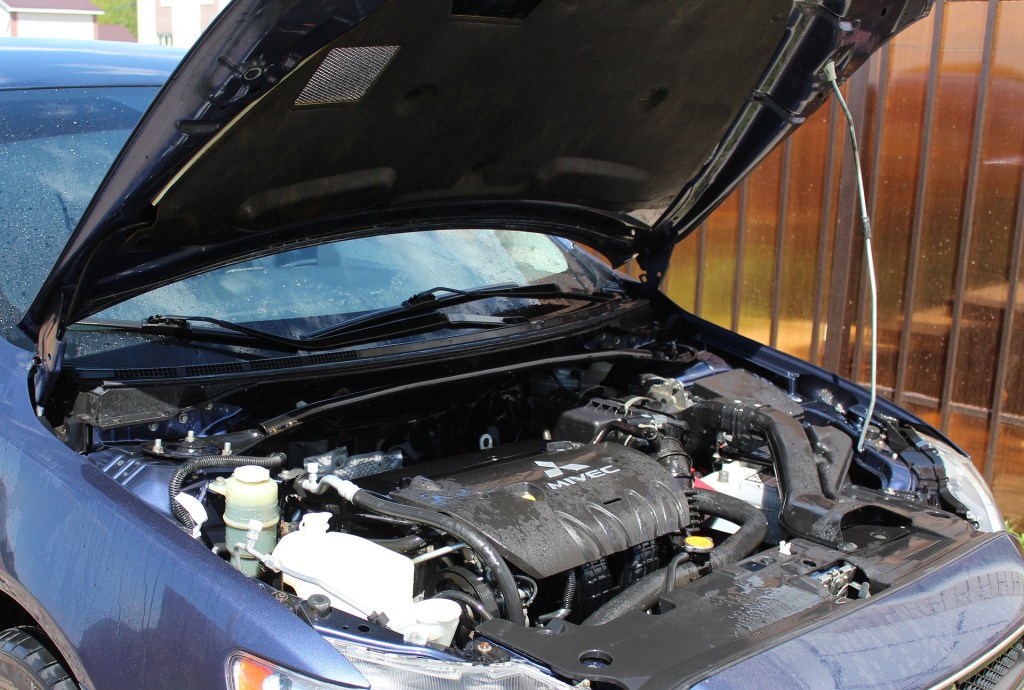
I was reading some of my journal entries and came across this one:
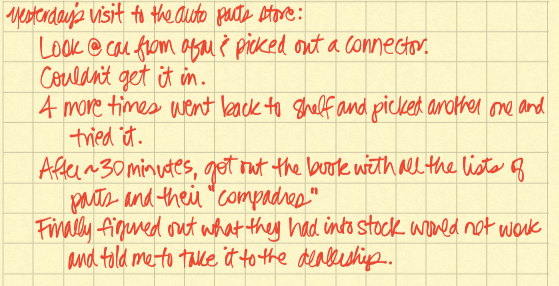
Here’s the problem. I don’t like to ask for help. Unfortunately for me, this often creates frustration, wastes time, and makes me look foolish.
The only good solution involves owning my uninformed state and (1) find reliable references that might have the information I need. (There’s One Who has all the answers to life’s questions I consult regularly.) When I don’t understand what is in the book or the situation is still unresolved, (2) listen to someone else with more knowledge and skills. More often than not, they will willingly share their knowledge and skills with me. (I know Someone Who always gives good information to me.)
Unfortunately (and fortunately), I’m still learning this lesson.
 reneshelton