I’m so glad God never changes and He is always helps me learn His ways are better. They may not be easier, but they are better.

I’m so glad God never changes and He is always helps me learn His ways are better. They may not be easier, but they are better.
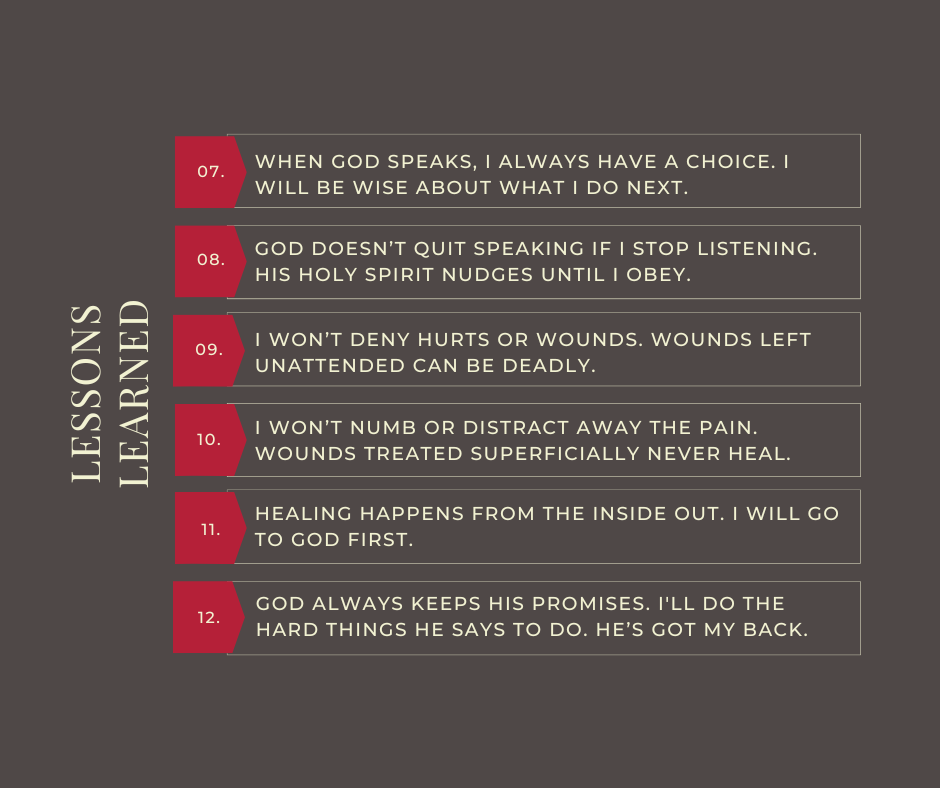
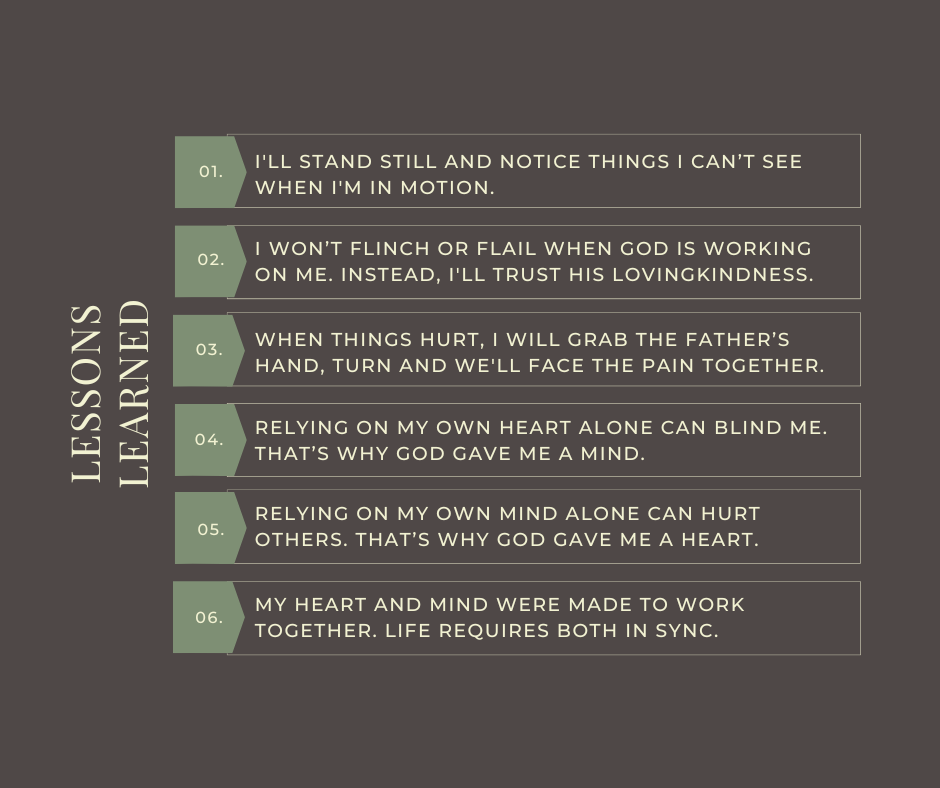
My last Lessons Learned post was right before Christmas . . . I’ve been quietly stashing away the lessons.
Mom taught me “Learn the lesson. Forget how you learned it.” Her words have helped me so much over the last 50 years and I don’t want to forget these lessons and have to relearn them. Maybe one or two will speak to you.
One lesson reads: I must first do what I ask of others. It’s easier to give grace when I see how much I need it.
In my journal it was written like this: Before asking someone else to be introspective, examine yourself. All the questions you ask others, ask yourself first. You will find that it is easier to give grace when you recognize you need grace.
I ask a lot of questions. (I see my friends nodding their heads.) And there were questions at the end of each post in the “Her Legacy in HIStory” series in March. Before I wrote those for you, I had to sit with them myself. At times, I was disappointed with the answers I had to give myself. Other times, I realized my thinking or feeling was unbalanced or selfish. And there were times when I was surprised by growth I saw since the last time I looked at that area of my life. My own answers pointed out that I constantly need grace and mercy. I am still learning lessons – and I will be until the day I die.
Please know my questions are not meant to create anxiety or uneasiness in you. My hope is they would give you a little glimpse into your own heart, your own mind, your own life, your own circumstances so you can take a tiny inventory to see if anything could be a little different, a little better. My Lessons Learned are not to brag. Some of these lessons come at a great cost. They are recorded to help me remember the grace and mercy God has extended to me and the important things He has taught me. (I don’t want to have to repeat some of these lessons!)
The good news is that if you find yourself in a place where you need grace and mercy, God is always willing to help. All we have to do is ask. We all need God’s grace because we will misstep and we need His mercy and comfort when the lessons feel too hard to complete. He’s promised never to leave us. He loves us that much!!
Heavenly Father, Thank You for grace and mercy that covers our failures. Thank You for never saying, “That’s it! You’ve had enough!” Your patience, kindness, goodness, and lovingkindness is overwhelming!

We can wait for problems to happen and then have an opinion about what went wrong.
But, why wait for trouble to happen when you can do some things to reduce it?
What if . . . we consider what might need to be learned and what might go wrong first and then help create a clear and better path?
The most effective, best loved teachers teach and train before they assess. They are proactive in their work.
The best assessing always comes after the teaching.
And the best response to failures is to first determine what went right and reinforce those things. Then, go back again and determine what went wrong and proactively address those concerns with compassionate reteaching.
For wise people, these things often happen internally, so be honest and kind to yourself. Give yourself mercy and grace as you learn.
After all, life is a series of learning opportunities!
During Women’s History Month 2023, we looked at more than 30 women mentioned in the Bible. Most of them were ordinary women during their lifetimes, but in retrospect they left amazing legacies from which we can learn how to have richer, deeper relationships – with God and with others. What would your profile look like?
Take some time and talk to your Heavenly Father about that question. The Creator of the Universe, the One who handmade you, the God who never changes, knows all there is to know about you and loves you more than you can image. Jesus Christ came from heaven to rescue you and bring you home with Him. And, the Holy Spirit, the Spirit of Truth and your Comforter, walks with you to give you everything you need to live a life pleasing to God. Lean into the faithfulness of your Heavenly Father, the love of Jesus Christ, and the hope provided by the Holy Spirit. Now, write your profile.
My name is . . .
My life reflects my name when . . .
My story: Currently being written
God has worked in my life this way and these times . . . Your story may never be recorded for posterity, but a record is being made. (Malachi 3:16; Psalm 40:8; Psalm 56:9; Psalm 139:16; Luke 10:20B) Because your story is still being written, it can be edited and revised.
My legacy: I want others to learn these important lessons He taught me . . .
Whether or not you are intentional about leaving a legacy, you will leave one. What do you want to leave? Your Heavenly Father has a wonderful plan for life grander than you could ever hope or imagine. He wants to make it a reality with you. He loves questions from a loving, humble heart. Talk to Him daily and always listen to what He has to say.
My response to Him today: Talk to Him daily and always listen to what He has to say.
Ask Him: As Your beloved child, how well am I moving closer to You each day? When others see me, do they see You more than me? In all I say and do, am I encouraging others to move closer to You?

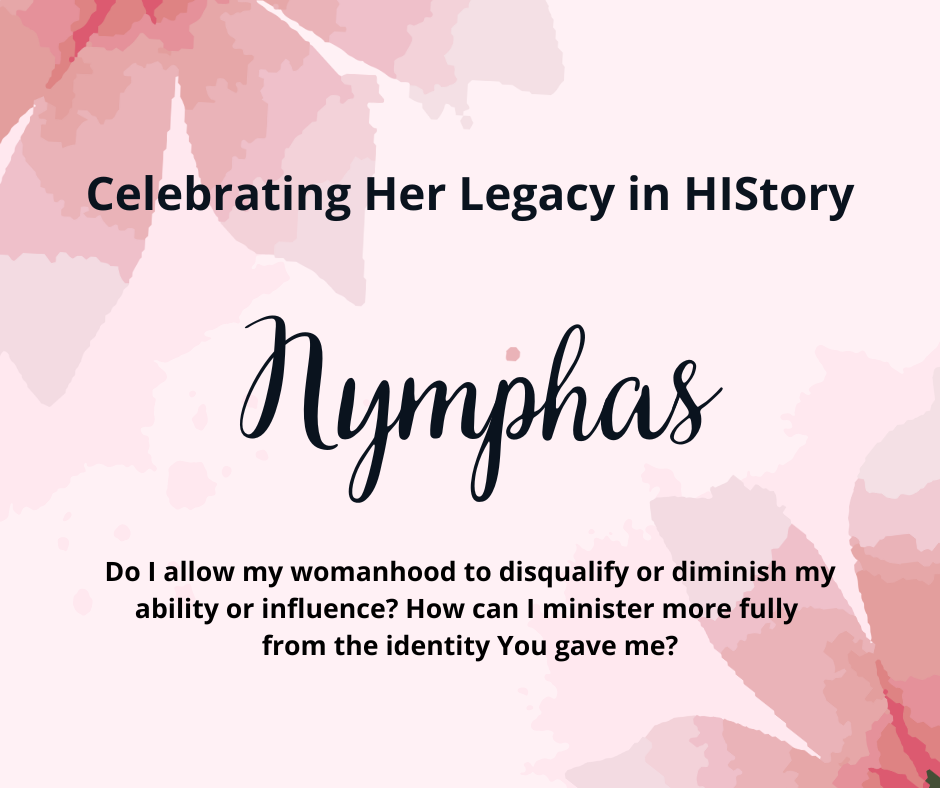
Her name in Hebrew means “bride”, coming from an ancient root that means “to marry”. She lived out her prophetic name/union with Christ and led, ministered, and served the bride of Christ out of that union.
Her story: Colossians 4:15-16
Nymphas is one of sixteen women who Paul mentions by name in his letters. Unfortunately, her gender was hidden when her name was masculinized in some Greek manuscripts. Perhaps a few scribes had difficulty with the idea that Paul was greeting a woman holding church meetings in her house, yet it was not uncommon for relatively wealthy women in the first century to host congregations for worship and fellowship, and care for them. Now modern English translations have unanimously correctly identified her as female. Looking at other passages that describe house churches and their leadership, we deduce that they gathered only around persons of some mark and leadership… described as beloved, fellow-laborer, one in whom “the saints are refreshed”, and minister. From the beginning of the early church, wealthy women were attracted to Christianity, and they were among the church’s patrons and protectors. Nymphas appears to be one such woman. Leaders of local churches did what was necessary, what they were capable of, and what they were gifted for. Due to her wealth, she was most likely literate, so she would have read and reread sermons, letters, and Scriptures. Since Paul addressed her specifically, even though there were other house churches in the area, suggests she was a well-known church leader.
Her legacy for us: Gender did not keep Nymphas from serving Jesus and His bride. She used her wealth, position, abilities, and influence to honor God.
Our response to Him: Do I allow my womanhood to disqualify or diminish my ability or influence? How can I minister more fully from the identity You gave me?
This guest post was written by Shawn Martin, my creative, courageous, godly friend. I love hearing what God shows her and learning artsy things from her. She always invites me into conversations that encourage and challenge me to deepen my relationship with the Master Creator. Find Shawn’s artwork and journals at her Etsy shop at this link, CrownofBeautybySM.
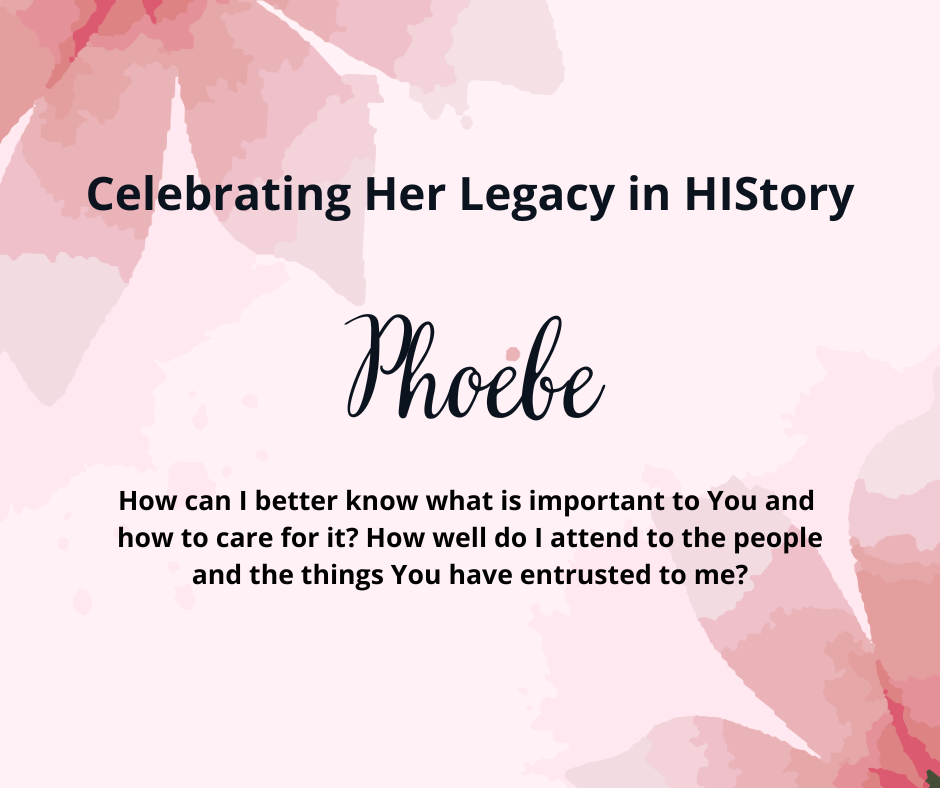
Her name means “radiant” and comes from a word associated with the light that comes from a lamp. Her life reflected The Light of the World.
Her story: Acts 16:1-2
At the end of the letters Paul wrote, he greeted members of the community where the letter went and sent greetings from his ministry team. The list at the end of Romans begins with Phoebe. Paul introduced her to the church in Roman as his sister-in-Christ and a servant of the church in Cenchrea. When Paul left Ephesus, he went to Cenchrea, a sea-port near Corinth, to minister. He met Phoebe there. Paul asked the church in Rome to welcome her with hospitality in the way they would welcome other Christians. He instructed them to help her with whatever she needed because she had been a woman who had helped many. Paul himself received help from her. The word he used to describe her can be properly translated as a woman set over others and historians believe she was a deaconess in the church in Cenchrea. The word can also be translated as a female guardian, a protector and a woman who cares for others and helps them out of her own resources. It is used only once in the Bible.
History says that Phoebe was on her way to Rome and Paul probably entrusted her with his letter. Although others traveled with her, she became the guardian and protector of this important letter.
Her legacy for us: When we attend to the things that God puts in our path with the same care and compassion He would, others often notice. Our goal is to reflect God’s faithfulness, His kindness, and His compassion.
Our response to Him: How can I better know what is important to You and how to care for it? How well do I attend to the people and the things You have entrusted to me?
Lois” means “agreeable” and Eunice means “good victory; victorious.” They were victorious in passing their faith on to one boy who impacted many.
Their story: 2 Timothy 1:3-7
Lois and Eunice are mentioned only once in Scripture, but Timothy is mentioned many times. Timothy traveled and worked with Paul. Paul often sent Timothy to check on the churches they had established and to help the new believers spiritually and practically with the ministry believers are called to do. Paul wrote two letters to Timothy filled with information he needed. They were also shared with the churches Timothy visited. In Paul’s second letter to Timothy, Paul reminded Timothy of his heritage and mentioned two women by name – Timothy’s grandmother Lois and his mother Eunice. Paul described their genuine faith and told Timothy he has it too. In other places, Paul wrote that when unpretentious, unwavering faith is combined with a pure heart and a clear conscience, it yields a love that is pure and loyal (2 Corinthians 6:6). This love is the inner work of the Holy Spirit and is expressed through kindness, wisdom, and patience (1 Timothy 1:5). Then, Paul encouraged Timothy to remember that God gave him authority and power, this agape kind of love, and the ability to make sound decisions.
Their legacy for us: It was a grandmother’s and mother’s example of loving God, trusting Him and loving others expressed in their ordinary daily lives that was passed down to the next generation. Whether we are intentional or not, our ordinary daily living is an example that will impact the younger generations we come into contact with and they will impact others. Each one an eternal being in a physical soul. Our reach is much bigger than we could imagine. We don’t have to have a big name or platform to make big differences.
Our response to Him: What can I do today that reveals by my actions I love You and trust You? How can I bring my children along as I reach out to others who need You? Regardless of the heritage I have received, help me bring the next generation closer to You.

She is best known by her nickname, Priscilla. Her name, Prisca, means “ancient” in Latin.
Her story: Acts 18:2-26; 1 Corinthians 16:19; Romans 16:3-5
Priscilla was married to Aquila. They were Italian Jews who left Rome when all Jews were ordered to leave the city. They moved to Corinth and it was there they met Paul. Because Paul and the couple were tentmakers and believers, they had much in common. They invited Paul to stay with them and they worked and ministered together. Paul lived with them while he evangelized to the Jews and Greeks. When Silas and Timothy came from Macedonia, Paul focused on the Jews and he moved to the house of another Jewish believer who lived near the synagogue. After that, persecution intensified. Paul and the couple stayed in Corinth for about a year and half, teaching the church there. Aquila and Priscilla also had a church in their home. Eventually, Paul, Aquila and Priscilla sailed to Syria and Ephesus. Aquila and Priscilla settled in Ephesus. Paul stayed a short time and then moved on. While he was gone, Aquila and Priscilla met Apollos, another teacher who was preaching the Gospel. After they heard him speak in the synagogue, they took him aside and explained the way of God more accurately, showing him where he did not fully understand Scripture and Christ. Priscilla and Aquila are mentioned in two of Paul’s letters. They are described as a couple who took great risks for Paul and who had a great impact on the Gentile churches. They ministered to others wherever they lived and had churches in their own home.
Her legacy for us: Others may recognize by our vocations, but our love for people and our actions to help and equip others is what identifies us as His children. Whether we meet physical needs or teach Biblical truth, we are the living-walking-around hands and feet of our Lord.
Our response to Him: How well do I recognize opportunities to meet the needs of those around me? When others look at my life, do they see an example of meeting temporal and eternal needs motivated only by my love for You?
Her name means “rose.”
Her story: Acts 12:11-16
Rhoda was a servant girl who worked for Mark’s mother. Mark (the writer of the Gospel of Mark) came from a Christian family living in Jerusalem and a church met in his mother’s home. Rhoda’s story took place when King Herod was on a rampage attacking the church. He killed James with a sword and when the Jewish leaders were pleased. So he arrested Peter and placed him in jail under two sets of guards. When Peter was jailed, the church gathered at Mark’s mother’s house and began to pray for Peter’s safety. At the same time they were praying, God sent an angel who woke Peter up. After the chains fell of of his wrists, the angel told him to get dressed and follow him. They walked past two sets of guards and out the iron gates into the street and the angel left him. Peter thought he was seeing a vision, but on the street, he “woke up” and recognized the reality of what God did. Peter thanked God and went immediately to the house where the church met. He knocked on the outer gate and Rhoda went to see who it was. She recognized Peter’s. She became so excited she forgot to let him in before running back and telling others that God answered their prayers. When she told those praying, they didn’t believe her and offered other explanations. Peter kept knocking until someone let him in and those who saw him were amazed. He explained how an angel broke him out of jail and helped him escape.
Her legacy for us: When things are hard, pray. When we pray, let’s be ready to receive an answer. Sometimes it takes a while for the answer to come, but sometimes answers come quickly. Whenever it comes, open the door, receive it, and let others know what God has done.
Our response to Him: When I pray, do I trust You will hear and answer? When You answer, do I express my gratitude to You and share Your work with others – regardless of the timeframe between request and answer, even when the answer looks different from what I expect, and regardless if others will believe me or not?

She was from Magdala.
Her name means “obstinate or rebellious.” The word obstinate comes from a Latin word that means resolved, determined, persistent. When Mary was healed, she persistently followed Jesus and became one of the first evangelists after His resurrection.
Her story: Matthew 27:55-61, 28:1-10 ; Mark 15:40-47, 16:1-11; Luke 8:2-3, 24:1-12; John 19:25-20:18
When Jesus traveled a second time in Galilee, he healed several women of sicknesses and casted out demons. On that trip, he freed Mary of Magda (a Magdalene) of seven demons. She was part of a group of women who followed Jesus and supported His ministry. Mary Magdalene was at Calvary when Jesus was crucified. She was in a group of women watching from a distance. When Jesus’ body was removed from the cross, Mary followed the men and saw the tomb where Jesus’ body was placed. Mary and her friends arrived early at the tomb on the first day of the week with spices to care for Jesus’ burial. At the tomb, they found the stone covering the opening rolled back. They met angels and were instructed to go and tell the disciples, especially Peter, that Jesus had risen just as He said He would. The women quickly and quietly hurried back to the disciples and delivered the message. Peter and John ran back to the grave and Mary followed them. While they went inside, Mary met the angels again and Jesus. She didn’t recognize Him until He called her name. He gave her another message for the disciples and she delivered that message as well.
Her legacy for us: Once Mary found the Savior, she found ways to serve Him. She didn’t leave when things were hard, instead she continued to follow Him even when others were too grieved to follow. Every task she was given, she completed. Sharing the good news is a woman’s responsibility and privilege – it is not just for men to do.
Our response to Him: When You call my name, do I recognize Your voice? How can I become more diligent in following You? Who do You want me to “go and tell” about Your lovingkindness and saving grace?
 reneshelton